![Joint Exploration of the Twilight Zone Ocean Network [logo]](/themes/jetzon-NOC8X/logo.svg)
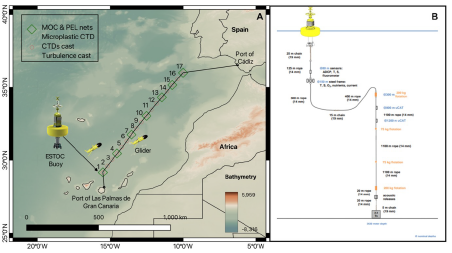
The GYROVAGO project (REF: PID2024-162612NB-I00) is a four-year multidisciplinary research initiative funded by “Agencia Estatal Consejo Superior de Investigaciones Científicas” in Spain, with collaboration from the Spanish Institute of Oceanography (IEO-CSIC), University of Cádiz and University of Las Palmas de Gran Canaria (ULPGC). GYROVAGO studies the variability of the Northeastern Subtropical Atlantic Gyre (ENASG), a key component in heat transport and biogeochemical cycles, and its impact on marine dynamics, carbon cycling, zooplankton, micronekton, and microplastics. Through oceanographic campaigns and long-term datasets, the project aims to understand the physical and biogeochemical processes affecting the ecosystem and the carbon cycle in the context of climate change. The Northeastern Subtropical Atlantic Gyre (ENASG) is a critical component of the North Atlantic system, influencing meridional heat transport and biogeochemical cycles. ENASG encompasses the Canary Current, which flows southward along the African continental slope and interacts with the Canary Coastal Upwelling at interannual, seasonal, and mesoscale levels. This upwelling affects ENASG biogeochemistry by supplying nutrients and enhancing phytoplankton productivity. However, in the era of Global Change, surface warming and the consequent increase in stratification and weakening of vertical turbulent mixing may reduce nutrient fluxes, thereby decreasing productivity. There is also an increasing trend in extreme events such as marine heatwaves, potentially impacting marine ecosystems. These changes also affect the biogeochemical carbon cycle, which in turn interacts with trophic dynamics.
Nearly 30 years of data from the European Station for Time-series in the Ocean, Canary Islands (ESTOC) highlight the importance of variability across multiple scales and long-term trends, not only in the surface layer but also at intermediate depths where Antarctic Intermediate Water and Mediterranean Water interact. Nevertheless, full understanding of the ENASG remains limited due to its spatial heterogeneity, diverse water masses, and the large number of complex multi-scale interacting processes. Zooplankton and micronekton, fundamental components of the marine ecosystem, contribute to the Biological Carbon Pump through Daily Vertical Migration, transferring carbon to deeper layers. The subtropical and subpolar North Atlantic acts as an important CO2 sink, although uncertainties remain regarding the variability of CO2 fluxes, influenced by physical, air-sea, and biological interactions. This project aims to investigate the variability of the ENASG and its manifestation in marine dynamics, water mass properties, zooplankton and micronekton biomass, and CO2 fluxes. Additionally, it seeks to characterize the distribution of microplastics in the region and their variability. To achieve this, a multidisciplinary, multiplatform oceanographic campaign will be carried out to complement existing observations and the long-term ESTOC time series. This approach will allow the determination of spatiotemporal variability patterns of biogeochemical variables and microplastics, from diurnal and submesoscale scales to long-term trends, identifying the role of physical drivers and advancing the comprehensive understanding of the ENASG as a complex marine ecosystem and its role in the global carbon cycle and climate change mitigation.