![Joint Exploration of the Twilight Zone Ocean Network [logo]](/themes/jetzon-NOC8X/logo.svg)
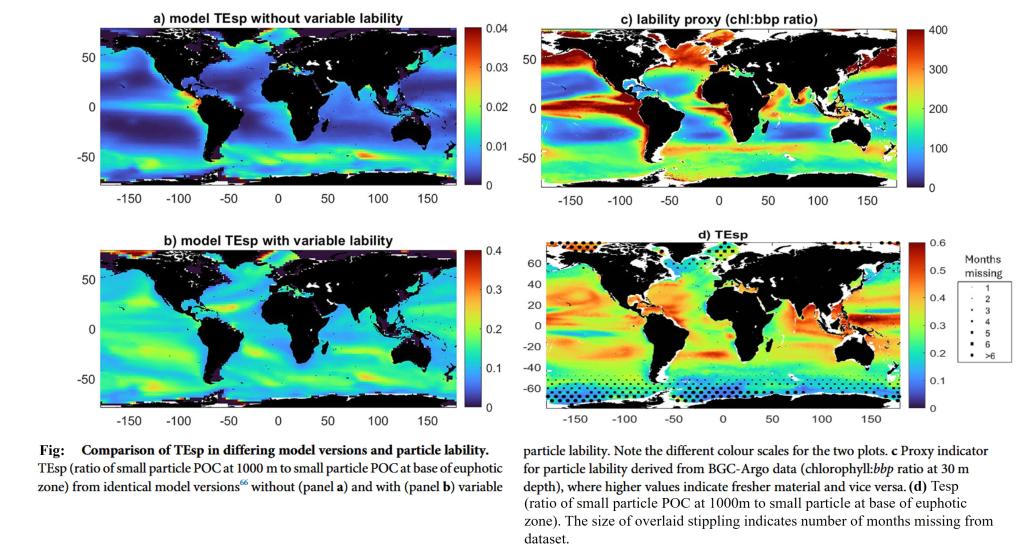
Particles smaller than 100 µm account for most of the particulate organic carbon found in the ocean's mesopelagic zone. Yet quantifying their abundance and carbon content with ship-based methods remains difficult, leaving their contribution to the ocean carbon cycle poorly understood. In this study, we draw on a 4D Biogeochemical-Argo data product to examine how small particles vary spatially and seasonally, along with their attenuation through the mesopelagic zone. Our results show that small particle loss is more pronounced at high latitudes than at low latitudes. We test several possible explanations for this pattern, though gaps in available data limit how definitively we can interpret the results. Notably, temperature-driven remineralisation does not appear to be the main driver of these trends; instead, differences in particle lability emerge as a more likely explanation for the observed latitudinal pattern.
- Log in to post comments