![Joint Exploration of the Twilight Zone Ocean Network [logo]](/themes/jetzon-NOC8X/logo.svg)
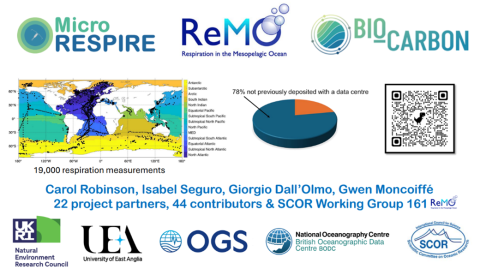
A major new dataset bringing together measurements of marine microbial respiration from across the global ocean is now available:
https://www.bodc.ac.uk/data/published_data_library/catalogue/10.5285/4b…
Citation:
Robinson C.; Seguro I.; Dall'Olmo G.; Moncoiffé G.; Aranguren Gassis M.; Aristegui Ruiz J.; Azzaro M.; Baek Y.; Baltar F.; Cohn M.R.; Eissler Y.; Evans C.; Fennel K.; Fernandez Urruzola I.; Ferrón S.; Fukuda H.; Garcia-Martin E.E.; Gifford S.; Goddard-Dwyer M.; Hernández-Hernández N.; Herndl G.; Hill P.; Huang B.; Huang Y.; Hyun J.; Kim B.; Kirchman D.; Kitidis V.; LaBrie R.; Lefèvre D.; Lønborg C.; Maranger R.; Martinez Garcia S.; Montero M.F.; Mouriño-Carballido B.; Nagata T.; Osma N.; Panton A.; Regaudie de Gioux A.; Reinthaler T.; Serret P.; Sulpis O.; Uchimiya M.; Wang B.; Wang Q.; Yokokawa T.(2026). A global dataset of marine pelagic microbial respiration. NERC EDS British Oceanographic Data Centre NOC. doi:10.5285/4b2a5ac6-b6db-c98e-e063-7086abc040c6
DOI: 10.5285/4b2a5ac6-b6db-c98e-e063-7086abc040c6
Collated through the UK research project MicroRESPIRE and the international Respiration in the Mesopelagic Ocean (ReMO) working group, the compilation represents one of the most comprehensive efforts to date to synthesise respiration measurements in the ocean’s mesopelagic zone (the “twilight zone”) between 200 and 1000 metres depth.
The work was supported by the UK Natural Environment Research Council (NERC) through the BIO-Carbon programme and by the Scientific Committee on Oceanic Research (SCOR), including funding from the U.S. National Science Foundation.
- Log in to post comments